 how-to
7 Recovery Strategies for Delayed Roofing Installations
Last Updated: November 4, 2026
Quick Summary
Recovery strategies for delayed roofing start with rebuilding the project timeline around confirmed dates, then writing a schedule recovery plan that assigns owners and dates to every remaining task. Seal any open deck with temporary protection, tighten contractor communication, and line up approved material substitutions so crews are never idle.
- Rebuild the timeline from scratch and confirm each date with the person responsible.
- Compress the critical path first, since a slip there delays the whole job.
- Overlap tarp edges and secure with battens so water runs off instead of pooling.
- Set a weekly written status update with photos and a named site supervisor.
- Keep a second supplier and an approved alternate for each key material.
Table of Contents
- Why Roofing Installations Get Delayed and What It Costs You
- Step 1: Reset the Roofing Project Timeline With Realistic Dates
- Step 2: Build a Roof Installation Schedule Recovery Plan
- Step 3: Set Up Temporary Roof Protection During Delays
- Step 4: Tighten Roofing Contractor Communication and Accountability
- Step 5: Use Material Substitutions and Supply Contingencies
- Step 6: Document Delays, Permits, and Contract Terms
- Step 7: Decide Whether to Repair First or Hold for Full Replacement
- Frequently Asked Questions
Why Roofing Installations Get Delayed and What It Costs You
Recovery strategies for delayed roofing installations start with understanding why the delay happened. A roofing installation is the sequence of tear-off, decking repair, underlayment, and final roof covering, and any break in that sequence exposes your home to weather.
The cost is not just time. An open roof deck invites water intrusion, which can soak insulation and stain ceilings within days. Delays also strain your budget as rental equipment, dumpsters, and temporary housing stay on the clock longer.
- Material shortages push the start date without warning
- Weather windows close fast in storm season
- Permit and inspection backlogs stall the crew mid-project
- Crew scheduling conflicts leave a half-finished roof exposed
The good news: a delay is recoverable. Below, seven steps cover how to reset the schedule, protect the structure, and get the job finished. If you want to prevent the next delay before it starts, our guide on how to avoid roofing delays covers the groundwork.
Step 1: Reset the Roofing Project Timeline With Realistic Dates
The first move is to rebuild the roofing project timeline from scratch, not patch the old one. Sit down with your contractor and list every remaining task in order. Then assign each task a start and end date based on what is actually confirmed, not what was hoped for.
Most delays compound because the original schedule assumed perfect conditions. A realistic reset builds in buffer for weather, inspections, and delivery windows.
- Confirm material delivery dates in writing
- Ask the crew lead for real availability, not a guess
- Add a weather buffer for each phase
- Set a new completion target you can defend
Watch out: rebuilding a timeline around wishful dates just resets the clock on the same failure. Build in slack and confirm each date with the person responsible.
Step 2: Build a Roof Installation Schedule Recovery Plan
A roof installation schedule recovery plan is a written document that maps how you will close the gap between the missed deadline and a new finish date. It assigns owners, dates, and dependencies to every remaining task so nothing drifts.
Start by listing every remaining task in sequence: tear-off completion, decking repair, underlayment, flashing, and final covering. Then mark the critical path, the chain of tasks where any slip delays the whole job. For example, if decking repair is waiting on a permit inspection, that inspection is on the critical path; shingle delivery may not be. Compress the critical path first.
Sequencing Work Around Material and Crew Availability
Line up the work so crews are never idle waiting on materials, and materials never sit exposed waiting on crews. If shingles are backordered but the decking repair is ready, do the decking first. If the crew is booked but materials have arrived, stage them under cover. A common pattern is to group tasks that use the same crew into one block, for instance, schedule all flashing work together, to reduce mobilization time. For broader tactics that keep the revised plan on track, see our guide on preventing construction delays on residential projects.
- Schedule inspections before the crew is on site to avoid standby time.
- Stage materials in delivery order, not storage order, so the first-needed items are accessible.
- Keep a backup task ready for weather days, such as interior attic inspection or site cleanup.
- Confirm crew availability in writing for each phase, not just the start date.
Watch out: compressing the schedule by overlapping tasks that require dry conditions (like underlayment and shingle installation) can backfire if rain interrupts; build in a weather buffer for each phase.
Resequencing and Adding Crews
If the critical path is long, consider resequencing work to run parallel tasks where safe. For example, while one crew installs underlayment on the main roof, another can prep the garage roof if it's a separate section. Adding a second crew can help, but only if materials and supervision are available; otherwise, crews may step on each other's work.
Set milestone dates for each phase, decking complete, underlayment complete, final inspection, and review them weekly.
Step 3: Set Up Temporary Roof Protection During Delays
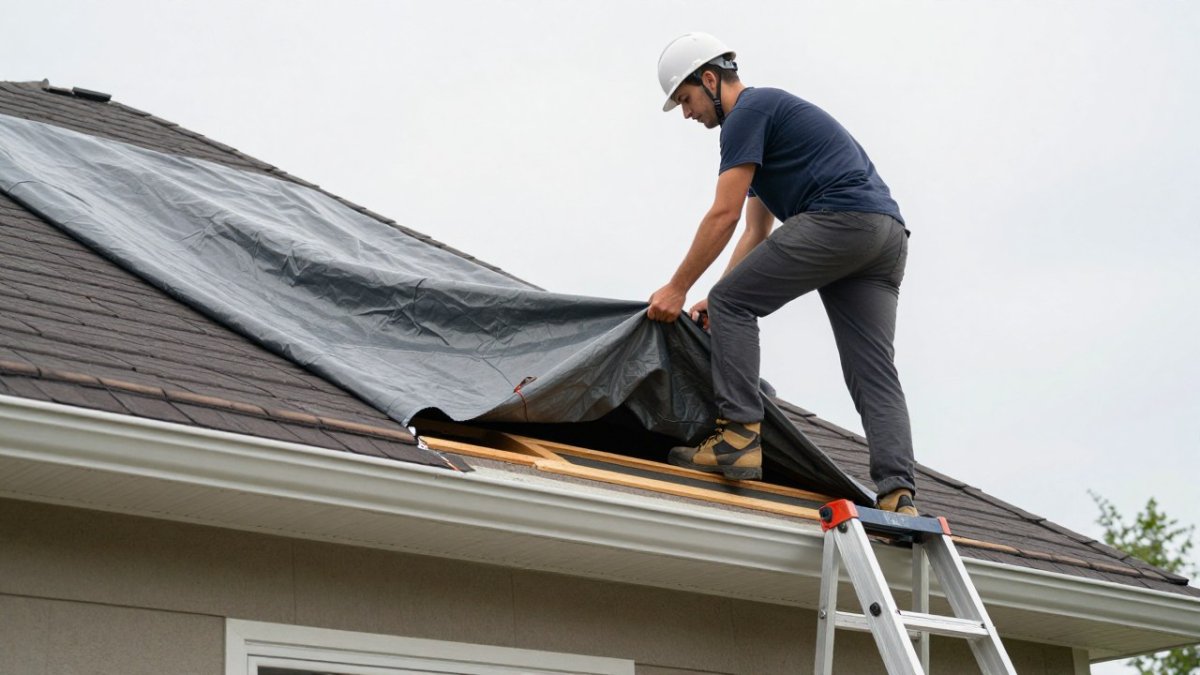
Temporary roof protection during delays means sealing any open or damaged area so rain and wind cannot reach the deck or the interior. A properly installed tarp or peel-and-stick membrane buys you weeks of safety while the schedule resets. Proper protection starts with the groundwork covered in our guide to site preparation for roofing.
The key is coverage that sheds water instead of pooling it. A tarp that sags collects water and fails fast.
- Overlap tarp edges so water runs off, not under
- Secure with battens, not just nails that tear the fabric
- Check seams and fasteners after every storm
- Replace torn tarps before the next rain
Interior Damage Mitigation While You Wait
Inside the house, move furniture and valuables away from ceilings under the open area. Place buckets and set up a dehumidifier if any moisture gets in. Photograph everything before and after, since your insurance claim may depend on it.
Step 4: Tighten Roofing Contractor Communication and Accountability
Roofing contractor communication is the difference between a recovered schedule and a runaway project. Set a fixed check-in rhythm, put updates in writing, and name one point of contact on each side. If you are still selecting a crew, our article on how to hire a contractor for small residential jobs covers setting expectations from the start.
Vague promises are the enemy here. Ask for specifics.
- A weekly written status update with photos
- A named site supervisor and a backup
- A clear escalation path for missed dates
- A shared task list both sides can see
Watch out: verbal assurances with no paper trail leave you with no use if the crew disappears again. Get every commitment in writing, even a text confirming the next date.
Step 5: Use Material Substitutions and Supply Contingencies
When the specified shingle or membrane is backordered, a material substitution can restart a stalled job. The trick is choosing a substitute that meets the same performance standard without voiding the warranty.
Work with your contractor to identify approved alternates before the delay bites.
| Situation | Recovery Move | Trade-off |
|---|---|---|
| Shingles backordered | Switch to an approved equivalent profile | Color or texture may differ slightly |
| Underlayment short | Use a compatible synthetic membrane | Confirm warranty compatibility |
| Flashing delayed | Fabricate on site to spec | Needs skilled labor and inspection |
| Ridge cap missing | Order from a second supplier | Possible small price difference |
Keep a supply contingency list ready for every phase. A second supplier and an approved alternate for each key material turn a crisis into a scheduling note.
Step 6: Document Delays, Permits, and Contract Terms
Documentation protects you if the delay turns into a dispute or an insurance claim. Keep a dated log of every delay, who caused it, and what it cost. Save all permits, inspection slips, and change orders in one folder. Then reread the contract for delay clauses, penalties, and completion terms.
A common pattern is to review the contract's delay clause: does it excuse delays for weather, material shortages, or permit backlogs? Does it require written notice? Many contracts include a time-and-materials provision that can increase costs if the project drags. Check payment milestones, if you've paid for a phase that hasn't started, you may have leverage to renegotiate.
- Log each delay with a date, cause, and any communication.
- Store permit and inspection records together with photos of the site.
- Note any change orders in writing, including who approved them and when.
- Confirm the contractor's insurance is current; a lapse can shift liability onto you. Our guide on how to verify contractor insurance coverage walks through the checks.
Watch out: verbal assurances about a new date are not enforceable; get every commitment in writing, even a text confirming the next milestone.
Warranty and Consumer-Protection Considerations
Review the warranty terms: does the delay affect coverage? Some manufacturer warranties require installation within a certain window after materials are delivered. Also check state licensing board rules, many require contractors to provide a written contract and a notice of cancellation right. If the delay is due to contractor negligence, you may have recourse through the state licensing board or small claims court.
Step 7: Decide Whether to Repair First or Hold for Full Replacement
Sometimes the smartest recovery is a repair-first approach. If the delay is long and the existing roof still sheds water, a targeted repair can stop damage while you wait for the full replacement. A slope-by-slope inspection tells you where the real risk sits.
Repair first makes sense when the damage is isolated and the structure is sound. Hold for full replacement when the decking or insulation is already compromised and a patch would just delay the inevitable.
- Repair first: isolated leaks, sound decking, short delay
- Hold for replacement: widespread damage, wet insulation, long delay
- Roof recovery: an option when the existing deck can take another layer
- Full tear-off: the safest choice when the old roof is failing
The right call depends on your roof condition and budget.
Frequently Asked Questions
What should I do first if my roof installation is delayed?
Get the new dates in writing before anything else. Ask the contractor for a revised roofing project timeline that lists the material delivery window, crew start date, and inspection slot. Then confirm what temporary roof protection during delays is in place, especially if decking is exposed. Document the original schedule, the reason for the delay, and the revised dates in one file. That record protects you if costs or damage claims come up later, and it gives the crew a clear target to work toward.
Can weather delay a roof installation, and how long can it push things back?
Yes. Rain, high wind, and temperatures outside the shingle manufacturer's application range will stop work, because most asphalt shingles need a dry deck and moderate temperatures to seal properly. A single storm system can cost several working days once you account for drying time and crew rescheduling. Build weather contingency into the schedule from the start rather than treating it as an exception, and ask the contractor how many weather days they typically absorb before the completion date moves.
What is the 25 percent rule in roofing and does it affect my delayed project?
It matters during a delay because exposed or poorly protected decking absorbs water the longer it sits. If your installation is stalled, have the contractor check for wet insulation and soft decking before work resumes. Catching saturation early can prevent structural damage and change whether you recover or tear off.
How do I keep a roofing contractor accountable after a schedule slip?
Put the recovery plan in writing and tie it to checkpoints. Ask for a weekly update on a fixed day, a named point of contact, and notice of any change within 24 hours. Photograph progress at each stage. If the contractor misses the revised dates without a documented reason, escalate in writing and reference the contract's completion and delay clauses. Clear roofing contractor communication from day one, with everything confirmed by email, is what keeps a delayed project from drifting further.
A delayed roof is a problem, but it is a solvable one. The homeowners who recover fastest are the ones who reset the schedule early, protect the structure, and hold everyone to written commitments. M7 LLC brings professional roofing and construction services built to last, from accurate scheduling to durable installation, so your project finishes on a plan you can trust. Get started with M7 LLC and put your roofing project back on track.