 how-to
How to Verify Contractor Insurance Coverage
Table of Contents
- Why Verifying Contractor Insurance Coverage Matters
- What Is a Certificate of Insurance for Contractors
- Step-by-Step Process to Verify Contractor Insurance
- Verifying Workers' Compensation for Contractors
- Questions to Ask Roofing Contractors Before Hiring
- Red Flags and Common Mistakes to Avoid
- Frequently Asked Questions
Last Updated: September 23, 2026
Why Verifying Contractor Insurance Coverage Matters
Hiring a contractor without the ability to verify contractor insurance is like driving without a seatbelt. You're exposed to risk you don't fully understand until something goes wrong.
When a contractor gets injured on your property, property damage occurs, or a project fails, you could be liable. Their insurance protects you. Your insurance may not cover contractor-related incidents. That gap is where financial disaster happens.
Verifying contractor insurance coverage protects your home, your finances, and your peace of mind. It's the single most important step before signing any contract.
What Is a Certificate of Insurance for Contractors
A Certificate of Insurance (COI) is a document issued by an insurance company that proves a contractor has active coverage. It shows the policy number, coverage limits, and effective dates. It's not the full insurance policy, it's a summary page that confirms protection is in place.
The COI lists three key pieces of information:
- Policy holder: The contractor's legal business name
- Insurance carrier: The company providing the coverage
- Coverage types and limits: General liability, workers' compensation, and other relevant policies
A legitimate contractor can provide this document in minutes. If they can't or won't, they don't have insurance.
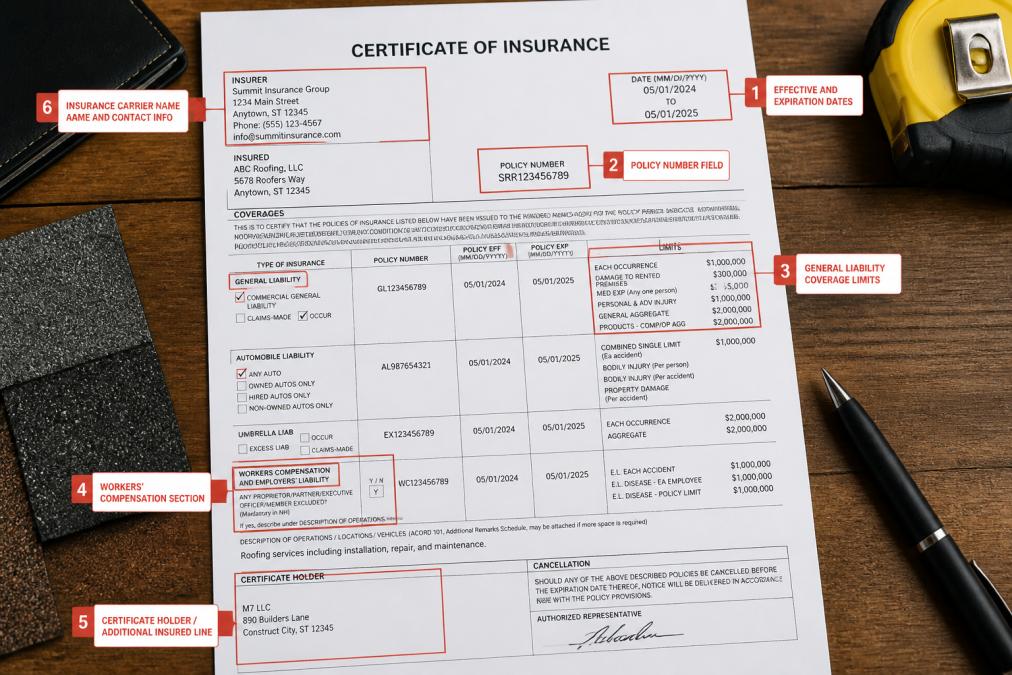
Key Details on a Certificate of Insurance
When you receive a COI, check these specific fields in order:
Effective Date and Expiration Date
Insurance must be current. An expired policy means zero coverage. Check that the effective date is before today and the expiration date is in the future. Many contractors renew annually on the same date each year; if renewal is coming up soon, ask when the new certificate will be issued.
For roofing projects, request that the expiration date extend at least 30 days beyond your project's scheduled completion date. This protects you if issues are discovered after work is finished.
Coverage Limits
Coverage limits are the maximum the insurance company will pay if something goes wrong. For roofing work, general liability limits should be at least $1 million. This covers property damage (e.g., damage to your home or neighboring properties) and bodily injury (e.g., an employee falling off your roof).
Workers' compensation limits vary by state but should cover all employees and subcontractors on the job. Ask the contractor how many workers will be on-site and confirm the policy covers that number.
Certificate Holder Information
The COI should list you (the homeowner or property owner) as an "additional insured." This means the policy protects you too if something happens during the roofing work. If you're not listed, request that you be added before work starts. This is a standard request and takes the contractor's insurance agent minutes to process.
Insurance Carrier Name
The carrier name should be a real, established insurance company. Google the company name plus "insurance" to verify it exists. Scammers sometimes use fake or lookalike insurance company names. You can also cross-reference the carrier name against the National Association of Insurance Commissioners (NAIC) database to confirm it's licensed to operate in your state.
Step-by-Step Process to Verify Contractor Insurance
Verification takes about 30 minutes. Follow these five steps in order.
Step 1: Request the Certificate of Insurance
Ask for the COI in writing. Email is best because you have proof they received the request.
Use this email template:
Subject: Certificate of Insurance Required Before Project Start
Hi [Contractor Name],
Before we move forward with the roofing [repair/replacement/installation], I need a current Certificate of Insurance. Please email me the document within two business days.
The certificate should show:
- General liability coverage of at least $1 million
- Workers' compensation coverage for all employees
- My name (or my property address) listed as an additional insured
- Current effective and expiration dates
Thank you, [Your Name]
A legitimate contractor will send it immediately. If they delay or refuse, this is a red flag. Do not proceed without proof of insurance.
When you receive the COI, verify it's on official letterhead from the insurance company (not a PDF the contractor created themselves). The document should display the insurance company's logo, address, and phone number.
Step 2: Verify General Liability Coverage
General liability insurance covers property damage and bodily injury caused by the contractor's work. For roofing projects, this is essential because work occurs on your home and involves fall hazards.
On the COI, find the line that says "General Liability" or "Commercial General Liability." Check these details:
- Coverage limit: At least $1 million is standard for roofing work
- Effective date: Must be before today
- Expiration date: Must be after your project ends (add 30 days for safety)
If the coverage limit is lower than $500,000, ask the contractor why. For most roofing projects, this is too low and indicates either a very small operation or inadequate coverage.
Step 3: Check Workers' Compensation Status
Workers' compensation insurance covers medical bills and lost wages if a contractor's employee is injured on your property. This is critical for roofing work, which carries high injury risk.
On the COI, find the workers' compensation section. Verify:
- Coverage is listed: It should show a policy number and coverage limit
- It's current: Effective date before today, expiration date in the future
- All employees are covered: The policy should cover all workers on the job
If the contractor says they have no employees (they're solo), some states don't require workers' compensation. However, even solo contractors should carry general liability insurance. Confirm your state's requirements by visiting your state's labor board website (search "[your state] workers' compensation requirements").
Step 4: Contact the Insurance Agent Directly
Don't trust the COI alone. Call the insurance company listed on the certificate to verify the policy is active and the details match.
Use this phone script:
"Hi, I'm about to hire [Contractor Name] for a roofing project. Can you confirm they have an active general liability policy with limits of [amount from COI]? The policy number is [number from COI]. Also, can you verify that [your name/address] is listed as an additional insured?"
The agent will verify coverage in seconds. If the policy doesn't exist, has been cancelled, or the limits don't match the COI, you'll know immediately.
Keep the agent's name, confirmation date, and any details they provide. Ask them to email you a brief confirmation of coverage.
Step 5: Verify Contractor Licensing and Bond Status
Insurance is one layer of protection. Licensing and bonding add two more.
Use this approach:
- Search "[your state] roofing contractor license board" or "[your state] contractor licensing board"
- Enter the contractor's name or license number
- Verify the license is current (not expired or suspended)
- Check if there are any complaints or disciplinary actions listed
Verifying Workers' Compensation for Contractors
Workers' compensation is the most important coverage after general liability. It protects both you and the contractor's employees.
On the COI, workers' compensation should show:
- A policy number: Proof it's real
- Coverage limit: Usually tied to payroll
- All employees covered: Including part-time and temporary workers
- Effective dates: Current and future coverage
Questions to Ask Roofing Contractors Before Hiring
Beyond insurance, ask these questions to evaluate the contractor:
"How long have you been in business?"
Established contractors have been around for at least 5-10 years. New contractors might be fine, but they're riskier.
"Can you provide references from recent projects?"
"What's your payment schedule?"
"Do you pull permits for this work?"
"What warranty do you offer?"
"Who supervises the job?"
Red Flags and Common Mistakes to Avoid
Mistake 1: Trusting the COI without calling the insurance company.
Mistake 5: Skipping the licensing and bond check.
Mistake 6: Hiring based on price alone.
Frequently Asked Questions
How can I verify if a roofing contractor's insurance policy is currently active?
Contact the insurance agent listed on the Certificate of Insurance directly. Provide the policy number and ask the agent to confirm the policy is active, the coverage limits, and the expiration date. Never rely solely on the document the contractor provides, direct contact with the insurer ensures the information is current and accurate. Ask for written confirmation if possible.
What is the difference between general liability and workers' compensation for roofing contractors?
General liability covers damage to your property or bodily injury caused by the contractor's work. Workers' compensation covers medical expenses and lost wages if the contractor or their employees are injured on the job. Both are essential. General liability protects you from third-party claims; workers' compensation protects you from liability if someone working on your roof is hurt and sues.
Can I request a Certificate of Insurance directly from the contractor?
Yes, you should request it before work begins. A Certificate of Insurance is a standard document that contractors should provide without hesitation. Ask for it in writing and review it carefully. Verify the contractor's legal business name, policy numbers, coverage limits, and effective and expiration dates. If they refuse or delay providing it, that's a serious red flag.
What should I look for on a Certificate of Insurance document?
Check the contractor's legal business name, the insurance carrier name, policy number, policy effective and expiration dates, and coverage limits for general liability and workers' compensation. Verify that you (the homeowner) are listed as an additional insured if contractually required. Confirm the coverage is adequate for the scope of work. Any discrepancies or expired dates mean the contractor is not properly insured.